
The Prequel to the AI Revolution

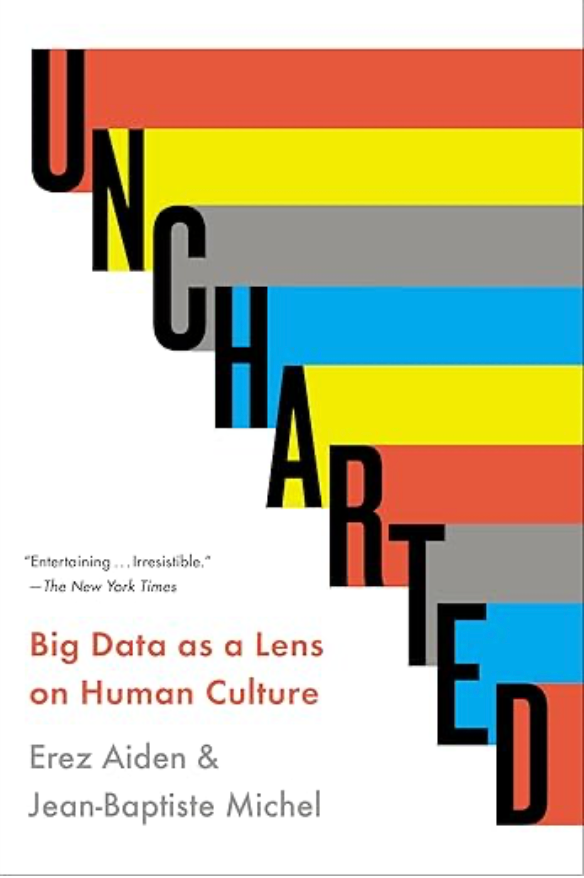
The "software is eating the world" era that has rapidly shifted to "AI is eating software". It is easy to suffer from the "recency bias" of the transformer architecture. We act as if the world began with the Attention paper in 2017. But to truly lead an engineering org through the current AI transition, you need to understand the statistical bedrock we are building on. That is why I revisited Erez Aiden and Jean-Baptiste Michel’s Uncharted. Originally published in 2013, the book introduces "Culturomics"—the study of human culture through the quantitative analysis of digitized texts (specifically the Google Ngram dataset). While the authors frame their work as a "telescope" to look at the past, for those of us building the "engines" of the future, this book is effectively the biography of the Ngram, the literal ancestor of the Large Language Models (LLMs) our teams are deploying today.
The Future is Probabilistic
Aiden and Michel describe "robot lexicographers" that parsed millions of books to track linguistic shifts like the move from "The United States are" to "The United States is." In 2013, this was digital archaeology sifting through "digital remains" to see where we had been. AI represents a brutal paradigm shift.
We have moved from archaeology to generative architecture, and most engineering leaders are still acting like they’re building bridges when they’re actually managing casinos.
For an engineering organization the lesson is clear: we aren't writing software anymore; we are orchestrating the statistical probability of human thought. Our value proposition has fundamentally shifted from "writing logic" to "curating the probability of logic." Here is the edgy truth: Logic is now a commodity; probability is the new theater of war. If you don't realize that your AI is just a high-velocity version of Aiden and Michel’s 2013 "robot," you are building a house of cards. In a deterministic world, if-then statements were our law. In a probabilistic world, there is no law, only weights and biases.
If we continue to manage people as if they are "logic-creators," we will fail. Their new job is "statistical arbitrage" - knowing when the model’s most likely path is actually a technical dead end. If you aren't comfortable with the fact that your product is now a series of "educated guesses" rather than hard-coded truths, you aren't an AI leader; you’re just a legacy manager waiting for the inevitable "black swan" event to crash your system. The future isn't coded; it's predicted. And predictions, by definition, are sometimes wrong. If your engineering culture can't handle being "wrong but statistically sound," you’re already obsolete.
The New Moat: Data and Your Unique Lens
One of the book’s most striking insights is the "half-life" of cultural phenomena: how quickly we forget. Aiden and Michel use data to show that while we reach the "peak" of fame faster, we are erased from the collective memory with equal velocity. This is a cold shower for every SaaS founder. We are seeing a terminal collapse in the "half-life" of code. If you think your software is an asset, you’re already behind.
With AI-assisted development, the cost of generating a feature is approaching zero. This creates an existential strategic crisis: if your "software" is as fleeting and easily reproduced as a 19th-century celebrity in the Ngram Viewer, your moat is non-existent.
Your codebase is no longer an intellectual property stronghold; it is a depreciating liability.
If an AI can recreate your entire SaaS product’s feature set in a weekend, my organization of 350 engineers isn't a competitive advantage, it’s an overhead nightmare. Uncharted indirectly provides the survival guide: value isn't in the output (the code), but in the archive (the data) and the lens (the proprietary model). Most of us are still running "feature factories" when we should be building "data-moat fortresses." If your engineers are still valued by how many tickets they close or features they ship, you are effectively paying them to produce commodities that AI will make free by next quarter. We must pivot. If you don't own a unique data signal that the robots haven't already indexed, you aren't a software company; you’re just a temporary interface waiting to be disrupted.
Don't Let AI Kill Innovation
Innovation is doing something in a novel way. But if our AI is fine-tuned on a "gated record" of yesterday’s best practices, it becomes a statistical engine of the status quo. It is trained to give us the most likely answer, not the best one. By fine-tuning our models on "industry standards," we are effectively lobotomizing our engineers' ability to think outside the consensus.
"Best Practices" are just the average of what worked five years ago.
When we leverage AI to develop our software, we aren't accelerating; we are anchoring. If we rely on a model that has indexed the gated record of "safe" architectural patterns, we will never build a disruptive system. We will build the most optimized, perfectly "aligned" version of a legacy product. For an engineering organization the paradox is lethal: The more we use AI to help us follow the "map" provided by the past, the less likely we are to ever discover "uncharted" territory. Our job as leaders isn't to make sure the AI knows the "best practices" it's to make sure our engineers know when to ignore them. If your AI only knows how to repeat the "gated record," then your entire org is just an expensive echo chamber for 2018's ideas.